Australia's Highest Paying Gold Buyers $$$


Silver Weight vs Silver Value: What's the Real Difference?
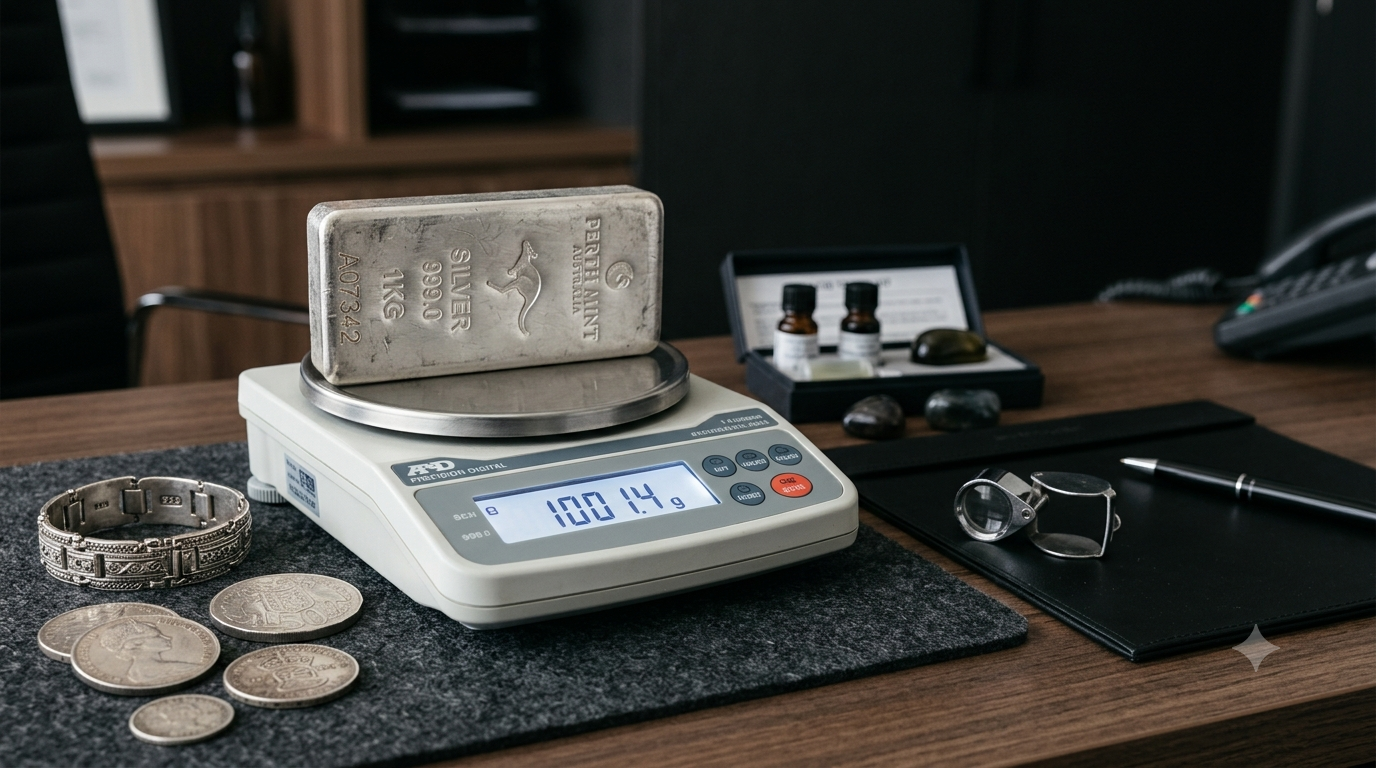
If you're thinking about selling silver, the first question is usually simple: how much is it worth?
The answer depends on more than what your scale says. Weight tells you how heavy an item is. Value depends on how much pure silver it actually contains, its form, its condition, and the current market price.
Two items can weigh exactly the same and still be worth very different amounts. A sterling silver item is about 92.5% silver. A .999 silver item is almost pure. That gap matters once you're ready to sell silver in Australia — whether you have bars, coins, jewellery, or old cutlery sitting in a drawer.
Weight Only Tells Half the Story
There are three terms worth knowing before you get anything valued:
Gross weight – the total weight of the item, including any non-silver parts.
Silver alloy weight – the weight of the metal that actually contains silver.
Fine silver content – the amount of pure silver inside it.
The formula is simple:
Fine silver content = alloy weight × purity
Purity is usually stamped somewhere on the item:
.999 or .9999 – almost pure silver, common in bullion
.925 – sterling silver, about 92.5% silver
.900 – found in some older coins
.800 – a lower-purity alloy
Silver plate – a thin silver layer over another metal
A silver-plated item shouldn't be valued the same way as solid silver. Most of its weight often comes from the base metal underneath.
Troy Ounces Aren't Regular Ounces
Silver is priced in troy ounces, not the ounces you'd use for cooking. One troy ounce equals 31.1035 grams. A regular ounce is about 28.3495 grams — noticeably lighter.
To convert grams to troy ounces:
Troy ounces = grams ÷ 31.1035
For example, a 100-gram bar of .999 silver contains 100 × 0.999 = 99.9 grams of fine silver. Divide that by 31.1035 and you get roughly 3.212 troy ounces of fine silver. That troy-ounce figure — not the gram weight — is what you compare against the spot price.
Checking Your Own Silver First
Before getting a professional valuation, you can do a few basic checks:
Weigh the item on a reliable digital scale.
Look for a hallmark or purity stamp.
Check for anything that isn't silver — gemstones, clasps, steel springs, solder, or fillers.
A magnet can rule out obviously fake metal, since real silver isn't strongly magnetic — but it can't confirm genuine silver on its own. A proper test from an experienced buyer is more reliable.
How Silver Value Is Actually Calculated
Melt Value Starts With the Spot Price
The spot price is today's market price for silver. It moves constantly, so an old price you saw months ago isn't useful for a current estimate.
Melt value = fine silver troy ounces × current spot price
Here's a worked example using a hypothetical price — not a live one.
Say you have a 30-gram sterling silver item marked .925.
30g × 0.925 = 27.75g of fine silver
27.75 ÷ 31.1035 = about 0.892 troy ounces
If silver were hypothetically $35 per troy ounce: 0.892 × $35 = about $31.23
This is a simple illustration, not a quote. A real buyer's offer depends on testing, refining costs, and their own margins — it won't match a back-of-envelope calculation exactly.
Melt Value Isn't Always the Final Story
Four terms are worth separating:
Melt value – the raw metal's estimated worth
Wholesale value – what a dealer might pay you
Retail value – what a buyer pays a customer
Collector value – extra value from rarity, age, or demand
Some coins and bullion pieces sell above melt value because of who made them or how rare they are — which is exactly why you shouldn't send everything straight to scrap without checking first.
Bars, Coins and Jewellery Don't Value the Same Way
Bullion bars and rounds are usually the easiest to value, since their price tracks closely with silver content plus a premium. That premium can shift with size, brand, and demand — a large bar and several smaller rounds might hold similar total silver but sell for different prices.
Coins can carry three layers of value: melt value, face value, and numismatic (collector) value. A common older coin often trades near its metal value, but a rare date or mint mark can be worth far more. Avoid cleaning old coins before they're assessed — cleaning can lower collector value rather than improve it.
Jewellery and household silver — bracelets, trays, candlesticks — are trickier. Clasps, stones, solder, and springs all sit outside the fine silver calculation, so simply weighing the whole piece and multiplying by the silver price will usually overstate its value.
Common Mistakes When Selling Silver
Mistaking silver plate for solid silver. Look for "EPNS," "silver plate," or "quadruple plate" markings.
Using regular ounces instead of troy ounces, which skews any estimate.
Selling a rare coin as scrap without checking its date, mint mark, or condition first.
Accepting the first offer. Ask each buyer how much fine silver they've calculated, what spot price they used, and whether any fees apply. A buyer who explains their numbers clearly is easier to trust.
What to Look For in a Silver Buyer
A good buyer should be upfront about how they test and weigh your items, and how they land on a final number. It's worth comparing more than one option — the same logic applies whether you're comparing local silver buyers or checking out a Gold Buyer in Mascot as part of your research. Look past the headline price and ask how the testing actually works.
If you're also holding onto gold, the same weight-versus-value principle applies — our guide on how to Sell Gold In Australia covers it in more detail. And if a Watch Buyer is next on your list, the same "ask before you sell" approach applies — our piece on the Top 7 Mistakes to Avoid When Choosing a Watch Buyer in Sydney walks through what to check.
Selling Silver in Sydney
If you're in Parramatta or anywhere across greater Sydney, Time & Gold at 260 Church St, Parramatta NSW 2150 buys silver bullion, bars, and coins. According to its website, purity and weight are checked in front of you, valuations are based on current market prices, and walk-ins are welcome with no appointment needed. If you're ready to sell, you can read more on our page for selling silver bullion in Sydney, or compare it against other options like the Best Gold Buyer in Sydney before you decide.
Weight Is the Starting Point, Not the Answer
The formulas worth remembering:
Fine silver grams = alloy weight × purity
Fine silver troy ounces = fine silver grams ÷ 31.1035
Melt value = fine silver troy ounces × current spot price
After that, condition, form, brand, and collector demand all play a part. Before accepting any offer, check the purity, work out the fine silver content, confirm today's market price, and get more than one valuation if you can. The heaviest item in your drawer isn't always the most valuable one — the amount of pure silver inside it is what actually counts.
Frequently Asked Questions
Is silver weight the same as silver value?
No. Weight tells you how heavy an item is. Value depends on purity, fine silver content, the current market price, and buyer demand.
What's the difference between a troy ounce and a regular ounce?
A troy ounce is 31.1035 grams. A regular ounce is about 28.3495 grams. Silver is priced in troy ounces.
Is sterling silver worth the same as pure silver?
No. Sterling silver is .925 purity — about 92.5% silver. A .999 item of the same weight contains more pure silver.
Can a silver coin be worth more than its melt value?
Yes, if it has collector value from its age, rarity, date, or condition.
Where can I sell silver bullion in Sydney?
Compare buyers on their testing process, pricing method, and transparency. Time & Gold, at 260 Church St, Parramatta NSW 2150, buys silver bullion, bars, and coins, checks purity and weight in front of customers, and welcomes walk-ins without an appointment.
Written By
Team Times&Gold
Visit Us in Parramatta!
NO APPOINTMENTS NEEDED!
Located inside DLUX Jewellers
Opposite Commonwealth Bank