Australia's Highest Paying Gold Buyers $$$


How Gold Buyers Value Jewellery With Diamonds and Coloured Gemstones
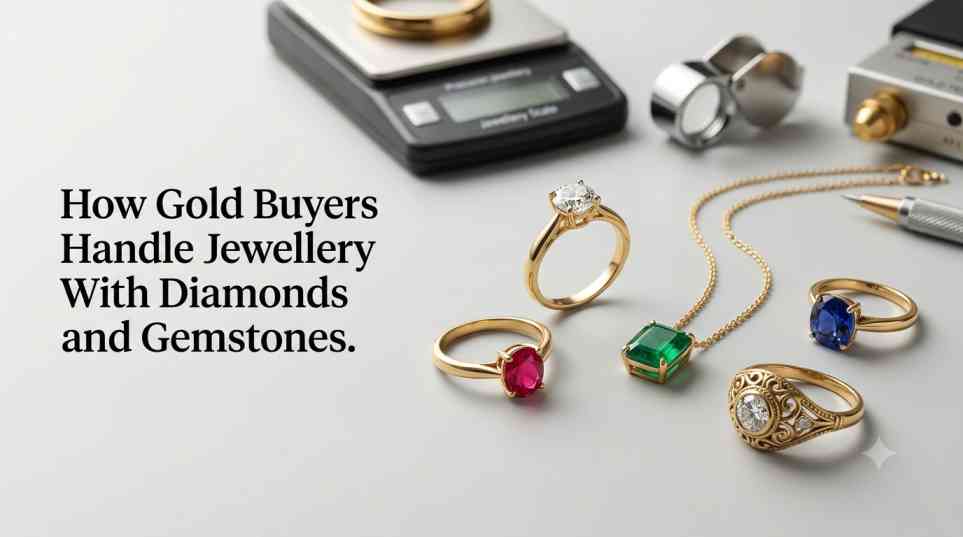
A gold ring set with a diamond is really two items in one: a measurable weight of gold and a stone whose value depends on quality, not weight alone. Most gold buyers start with the metal, then work out separately what the stones are worth. Understanding both halves of that process helps you make sense of any offer you receive in Sydney or Parramatta.
Two rings that look similar can end up with very different offers once purity, stone quality and condition are all taken into account.
How Gold Buyers Test and Weigh the Metal
Purity comes first
Gold jewellery is rarely pure. Common purities include:
24K / 999 – around 99.9% gold
18K / 750 – 75% gold
14K / 585 – 58.5% gold
9K / 375 – 37.5% gold
A hallmark can indicate purity, but stamps wear away on old pieces, so most buyers confirm purity with testing rather than relying on the mark alone. Common methods include acid testing, electronic testers and X-ray fluorescence (XRF), which reads the metal's composition without damaging the item. No single method is perfect, and not every buyer uses every method, so it's reasonable to ask what testing your item will undergo.
A simple purity calculation
As a hypothetical example: an 18K item weighing 20 grams contains roughly 15 grams of pure gold (20g × 75%).
This is a purity calculation only. It is not the amount you will be paid — refining costs, business margins and resale routes all affect the final offer, and it doesn't yet account for any stones.
Stones are weighed or valued separately
If a piece contains diamonds or gemstones, a buyer generally needs to account for that stone weight before pricing the gold, or assess the stones on their own merits. Methods vary between businesses — some estimate stone weight from measurements, others use a standard deduction, and specialist buyers may value valuable stones individually rather than treating them as dead weight.
How Diamonds Affect the Offer
The Four Cs, briefly
Diamonds are graded on four factors:
Cut – how well it's proportioned to reflect light
Colour – how close to colourless
Clarity – visible internal or surface features
Carat – weight, where one carat equals 0.2 grams
Carat weight is not the same as the total weight of your jewellery, and it is only one of four factors — two diamonds of identical carat weight can be worth very different amounts depending on cut, colour and clarity.
Grading reports help, but don't guarantee a price
If you have a report from a recognised laboratory such as GIA, IGI or HRD Antwerp, bring it. A report documents a diamond's characteristics and can support a stronger, more informed offer. It does not fix a resale price — that still depends on the buyer, the market and how the stone will eventually be resold.
Natural, lab-grown and treated diamonds are priced differently
Laboratory grown diamonds share the same basic chemical structure as natural diamonds but are priced differently in the current market. Gemological laboratories can identify laboratory-grown origin and disclose known treatments, such as laser drilling, on their reports. Never assume two diamonds of the same carat weight carry the same value — origin and treatment matter as much as size.
How Coloured Gemstones Are Assessed
Sapphire, ruby, emerald, alexandrite, aquamarine, tourmaline and tanzanite are all assessed on similar factors:
Strength and evenness of colour
Clarity and inclusions
Cut quality
Size
Origin, where this affects value
Treatment history
Colour is often the single biggest factor in a coloured gemstone's value, and for some stones, origin plays a strong role too. Inclusions aren't automatically a flaw — in some gemstones, they help confirm a stone is natural rather than synthetic.
Treatment doesn't mean worthless
Many coloured gemstones are routinely treated, and this is standard, accepted industry practice when disclosed. Sapphires and rubies are commonly heat-treated to improve colour and clarity, while emeralds are traditionally treated with oil or resin to reduce the visibility of fractures. A stone that is independently confirmed as untreated can command a premium precisely because it's less common — but a treated stone still has value. What matters is that the treatment is disclosed, not that it was done at all.
Why Brand, Age and Craftsmanship Can Matter More Than Melt Value
Designer pieces aren't automatically worth more
Names such as Cartier, Tiffany & Co., Van Cleef & Arpels and Bulgari can attract buyers beyond scrap value, but a brand name alone doesn't guarantee a premium. Value depends on authenticity, model, rarity, condition, original documentation and current demand. If you own a recognised designer piece, it's worth getting a second opinion before assuming it should be valued as scrap gold our Designer Jewellery Gold Value: What Sydney Buyers Pay page covers this in more detail.
Antique jewellery deserves a closer look
Age, design and craftsmanship can add value beyond the gold content. As a hypothetical example, a signed 1920s ring and an unmarked ring of identical gold weight could have very different worth if the signed piece has collector appeal. Ask any buyer whether they intend to resell, dismantle or refine an item before you agree to sell.
Understanding Different Types of Value
Sellers often confuse several distinct figures:
Retail price – what a similar new item sells for in a shop
Insurance valuation – the cost to replace the item, usually the highest figure
Wholesale value – what a trade buyer might pay another trade buyer
Resale value – what a buyer expects to achieve reselling the item or stone
Scrap or melt value – the gold content alone, stones aside
A cash offer from a gold buyer is rarely the same as an insurance valuation, and it isn't meant to be. Knowing which figure you're comparing helps set realistic expectations.
Questions to Ask Gold Buyers Before Selling
Before you accept an offer, it's reasonable to ask:
How was the gold purity tested?
What is the item's gold weight, separate from any stones?
Are diamonds or gemstones included in the offer, or valued separately?
Is the offer based on melt value or resale value?
Are there any deductions or fees?
Will stones be removed from the setting?
What happens if I decide not to sell?
A buyer who can answer these clearly is making it easier for you to compare offers.
Comparing Offers and Knowing When to Look Further
For valuable pieces, ask for a breakdown covering gold value, stone value, and any brand or antique premium, rather than a single lump sum figure. For anything with a large certified diamond, a significant designer name, strong antique appeal or family history, it can be worth getting two or three opinions potentially including a specialist jeweller, auction house or estate jewellery broker — alongside a standard gold buyer quote.
In NSW, businesses that buy second-hand jewellery, gemstones and precious metals operate under the Pawnbrokers and Second-hand Dealers Act 1996, which sets licensing and conduct standards for the industry.
The Smartest Way to Sell
Confirm the gold purity, separate the stone value from the metal value, and check for any grading reports before you decide where to sell. If you're comparing cash for gold Parramatta options or looking at gold jewellery Sydney buyers more broadly, ask each one how they reach their figure a clear breakdown makes it far easier to judge whether an offer is fair.
Before you sell:
Photograph the jewellery
Gather certificates, receipts and brand documentation
Avoid rushed repairs or polishing before a valuation
Ask how each stone was assessed
Request a breakdown, not just a total
Get a second opinion on rare or high-value pieces
A high gold price doesn't automatically mean a high offer for the whole piece. Good gold buyers explain what's driving your offer — the metal, the stones, the brand and the craftsmanship — rather than just naming a number.
If you'd like a professional, in-person valuation of gold, diamond or gemstone jewellery, visit Time & Gold's Parramatta showroom, where purity is tested and weighed in front of you before any offer is made.
FAQS
Does a diamond always add significant value to a gold item?
Not always. A diamond's value depends on its cut, colour, clarity and carat weight together, not carat weight alone, so small or lower-grade stones may add relatively little on top of the gold value.
Is a lab-grown diamond worth the same as a natural diamond of the same size?
No. Natural and laboratory-grown diamonds are priced differently in the current market, even when they share similar carat, colour and clarity grades.
Does a heat-treated sapphire or oiled emerald have no value?
No. Heat treatment in sapphires and rubies, and oiling in emeralds, are long-standing, widely accepted industry practices. Treated stones still have value — what matters is that the treatment is disclosed.
Should I get my jewellery valued before selling it?
For pieces with a designer name, a certified diamond, coloured gemstones or antique features, a professional valuation or second opinion can help you understand whether the item's worth extends beyond its gold content.
What's the difference between an insurance valuation and a gold buyer's cash offer?
An insurance valuation reflects the cost to replace an item at retail, usually the highest figure. A cash offer from a gold buyer reflects resale or melt value, which is typically lower.
Do I need to bring documents when selling gold or diamond jewellery?
Bring any diamond or gemstone certificates, receipts, brand papers and insurance valuations you have — they can support a more accurate assessment.
Are gold buyers in NSW regulated?
Yes. Businesses buying second-hand jewellery, gemstones and precious metals in NSW operate under the Pawnbrokers and Second-hand Dealers Act 1996, which sets licensing and conduct requirements.
Written By
Team Times&Gold
Journal Insights

Visit Us in Parramatta!
NO APPOINTMENTS NEEDED!
Located inside DLUX Jewellers
Opposite Commonwealth Bank